Newsflash: following Jesus doesn’t mean you won’t have enemies.
I’m not sure why that’s something we’ve come to believe, especially when Jesus actually said the opposite. Turns out, enemies are part of life on earth—like taxes, rainy days, and unexpected injuries in fantasy football.
While it doesn’t mean a life without enemies, following Jesus will (and should) have seismic effects on how we interact with them. It’s something worth diving into because—stop me if you’ve heard this one before—the world is pretty broken. These days, it feels easier to find enemies than friends.
Growing up, I thought my enemy was the mean girl on the rival soccer team, the one who always managed to trip me up. Or my parents, when they enforced rules I was convinced were old, outdated, and unnecessary. Or especially my high school math teacher, who regularly made me feel like an idiot for not understanding calculus (math should use numbers!).
As an adult, I think my enemy might be whoever sets the price of gas and groceries; or maybe it’s the mortgage company; or maybe it’s my neighbor who mows his lawn at 7:30 A.M. on a Saturday. Or maybe it’s just that guy at work who always craps on my ideas.
One ad on TV says the elephant is the enemy; the next one says the problem is definitely the donkey. There’s enough mudslinging back and forth, it’s hard to tell either side apart anymore. While politics can come into it, when Jesus talks about enemies, I think he has a more personal answer in mind.
Who comes to mind when you think of your enemies? The person you can’t stand to be in the same room with. The person who is consistently annoying, even on purpose. Someone you really don’t like, hate to see succeed, or can’t (or won’t) forgive.
Jesus famously preached “love your enemies, and pray for those who persecute you” (Matthew 5:44). If you’ve lived through an election cycle, a youth sports event, or an HOA meeting, you know this wisdom is rarely practiced. It’s so much more satisfying to hate our enemies instead.
Following Jesus means recognizing your enemies not so you can plot their demise, but so you know who to love; who to pray for; who to bless.
A Story That Changed Everything
Throughout the Old Testament of the Bible, written before the birth of Jesus, God’s people encountered a tremendous amount of enemies. Some were nations, like Egypt or Assyria, who sought to enslave or eradicate them. Other enemies came in the form of specific people: Goliath was David’s enemy; Haman was Esther’s; Ahab was Elijah’s. Sometimes (oftentimes) Israel was their own worst enemy—like when they wanted to return to slavery instead of following God through a challenging desert; or when they created a golden cow to worship because they wanted a physical God; or when a string of terrible kings led the entire nation into ruin.
There were many times in the Old Testament when God instructed his people to physically fight against their enemies. There was war and bloodshed, things that often rub up against our modern sensibilities. Those passages can be challenging and are worth wrestling through.
And yet, when Jesus came onto the scene, he shifted our perspective. No longer were enemies to be dominated and destroyed; they were to be served and loved. One way he taught this was through a story.
It all started when an expert in the Jewish law approached Jesus with a question.
This lawyer knew that the Old Testament Law, 613 rules and regulations that God set out for his people to follow, insisted that God’s people love their neighbors as themselves. The lawyer took the question one layer deeper.
“And who is my neighbor?” he asked Jesus.
Jesus answered by telling a story about a Jewish man going on a trip. The man was jumped by robbers and left for dead on the side of the road. Soon, a priest happened to walk by. The crowd expected the religious man to help the wounded traveler. But—gasp!—the priest walks on by.
Next, Jesus says that a Levite walks by. Consider this like someone who works at a church, but isn’t the pastor. Surely he’d stop and help the wounded man? No dice again.
Then, Jesus pulls a twist no one saw coming. A Samaritan came down the path and encountered the injured man.
For centuries, the Jews had hated their neighbors, the Samaritans. They considered them lowly, half-breeds, unworthy of anything but hate.
And yet, the Samaritan is the first person to do something different in the story.
“When he saw him, he had compassion. He went to him and bound up his wounds, pouring on oil and wine. Then he set him on his own animal and brought him to an inn and took care of him.” - Luke 10:33-34
When the Samaritan has to leave, he even pays the innkeeper to keep taking care of the man until he is fully recovered.
Jesus turns up the heat with a single question. “Which of these three do you think proved to be a neighbor to the man?”
The lawyer is so shaken, he can’t even say the word “Samaritan*.*”
“The one who had mercy,” he answers.
Jesus told him, ‘Go and do likewise.’”
I bet you could have heard a pen drop.
Neighbors? Enemies? N-enemies?
We’ve covered some ground, so let’s recap.
Jesus says I’m to love my neighbor as I love myself? Check.
But his story also instructs me to love my enemies, even going so far as to use my time and money to care for them? Check.
In Jesus’ mind, I’m supposed to treat my neighbors the same way I treat my enemies.
He basically pulled off the 1st-century equivalent of meme gold.
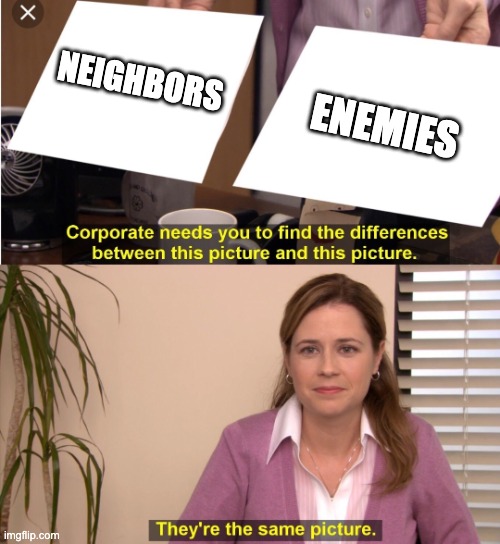
AND, to top it all off, he made a hated Samaritan the hero of one of his most famous parables? It’s almost like he was trying to say we wouldn’t be able to recognize our enemies by how they look, how they vote, or where they live.
That’s cool and all, but there are people who definitely don’t like me. They add stress, chaos, and tension to my life. They feel like my enemies. Are they?
A Man With Enemies
Paul, the missionary and church planter who wrote most of the New Testament, was a man who knew a little something about enemies.
Once a rising star among the religious elite, he had a life-altering encounter with Jesus. Turning his back on his old ways, he devoted the rest of his days to planting churches. At nearly every turn, Paul faced opposition.
This is how Paul describes his life, in his own words:
“Imprisonments, with countless beatings, and often near death. Five times I received at the hands of the Jews the forty lashes less one. Three times I was beaten with rods. Once I was stoned. Three times I was shipwrecked; a night and a day I was adrift at sea; on frequent journeys, in danger from rivers, danger from robbers, danger from my own people, danger from Gentiles, danger in the city, danger in the wilderness, danger at sea, danger from false brothers, in toil and hardship.” - 2 Corinthians 11:23-27
The list actually goes on, but you get the picture. The people who hated Paul, really hated Paul. And yet, because he had dedicated his life to following the example of Christ—who loved his enemies enough to ask God to forgive them even as they nailed him to a cross—Paul’s hardships didn’t harden his heart toward the people behind them.
Instead, he would write to a church facing harsh opposition:
“Let love be genuine… love one another with brotherly affection… Rejoice in hope, be patient in tribulation, be constant in prayer.
Bless those who persecute you; bless and do not curse them… Live in harmony with one another. Do not be haughty, but associate with the lowly. Never be wise in your own sight. Repay no one evil for evil, but give thought to do what is honorable in the sight of all. If possible, so far as it depends on you, live peaceably with all.
Beloved, never avenge yourselves, but leave it to the wrath of God, for it is written, "Vengeance is mine, I will repay, says the Lord.” To the contrary, “if your enemy is hungry, feed him; if he is thirsty, give him something to drink; for by doing so you will heap burning coals on his head. Do not be overcome by evil, but overcome evil with good.” - Romans 12:9-21
The Real Enemy
There is nothing easy about choosing to love your enemies, but things click into place when you realize that whoever you’d call your enemy, really isn’t the enemy at all. That title belongs to someone else.
Scripture describes him as a serpent; the father of lies; and a roaring lion looking for someone to devour. His name is Satan, which is a title as much as a name. In the ancient language of the Old Testament, that word means "accuser" or “adversary.” That’s precisely what he’s good at.
Although many people did wrong to Paul, he chose to point the finger in only one direction:
“For we do not wrestle against flesh and blood, but against the rulers, against the authorities, against the cosmic powers over this present darkness, against the spiritual forces of evil in heavenly places.” - Ephesians 6:12
So while individual people might make my life more difficult, they really aren’t the big baddie of my story. There is something deeper going on, involving a spiritual entity hell-bent on destroying God’s plans… including his good plans for my life.
Don’t take this too far. It doesn’t help to see devils hiding behind every corner… but when you realize that the people coming against you aren’t the tip of the spear, it allows compassion—and yes, even love—for them to grow.
(That’s not to diminish the real harm that other people can do. Abuse, exploitation, and pain are realities that far too many people have to face. Loving our enemies doesn’t give perpetrators a blank check, and it’s not a reason for you to stay in relationships where you are being mistreated. You are God’s beloved, and if you are in harm, you should seek safety. You deserve to live a life of joy and freedom.)
The God of Justice
Thankfully, learning to love our enemies doesn’t mean we have to be soft on justice. In fact, many heroes of the faith we find in Scripture make it a point to cry out to God when life feels unjust, like their enemies were finally going to get the upper hand.
One of the most iconic was King David. He wrote:
“How long must I take counsel in my soul and have sorrow in my heart all the day? How long shall my enemy be exalted over me?” - Psalm 13:2
And
“Though I walk in the midst of trouble, you preserve my life; you stretch out your hand against the wrath of my enemies, and your right hand delivers me.” - Psalm 138:7
And
“Contend, O Lord, with those who contend with me; fight against those who fight against me!” - Psalm 35:1
Turns out, God does just that. Scripture has plenty to say about justice—that God loves it, is its ultimate source, and commands His people to help bring it to the vulnerable. While it might seem so by our standards, God isn’t slow to bring about justice. Rather, he is patient, giving humanity chance after chance to turn from their destructive choices (2 Peter 3:9).
Because the world is broken, we are going to encounter people who feel like enemies. While our natural inclination is usually something else, Scripture's ultimate lesson is that God will bring about justice—for us, for our enemies, and for everyone on the earth.
There are lots of opinions on how we should understand the final book of the Bible, Revelation. But one thing we can all agree on: it shows that God will win in the end. The ultimate Enemy, Satan, will be defeated. So will death, sickness, and pain. Justice will win the day, and peace will be the final victory.
Life with Enemies
The bad news: enemies are here to stay (for now). The upside? We know how to deal with them. Following Jesus means taking on his example:
“You have heard that it was said, ‘You shall love your neighbor and hate your enemy.’ But I say to you, love your enemies and pray for those who persecute you.” - Matthew 5:43-44
Following Jesus means we love, even when we aren’t loved. We pray for, even when we’re rooted against. We return anger with compassion, and bitterness with forgiveness. We can do this because we trust that God will bring about justice; that the ultimate Enemy will be defeated; and a day is coming when the word “enemy” won’t mean anything to us anymore.
We aren’t there yet. But we can plant seeds for that kingdom now.
It all starts with us, and the decisions we make today.
Disclaimer: This article is 100% human-generated.
Reflections to share? Got an idea for an article? Email us at articles@crossroads.net
At Crossroads, we major on the majors and minor on the minors. We welcome a diverse community of people who all agree that Jesus is Lord and Savior, even if they view minor theological and faith topics in different ways based on their unique experiences. Our various authors embody that principle, and we approach you, our reader, in the same fashion. You don't have to agree with every detail of any article you see here to be part of this community or pursue faith. Chances are even our whole staff doesn't even agree with every detail of what you just read. We are okay with that tension. And we think God is okay with that, too. The foundation of everything we do is a conviction that the Bible is true and that accepting Jesus is who he said he is leads to a healthy life of purpose and adventure—and eternal life with God.
Wife and coffee aficionado; loves baking sourdough; working on caring for creation with every action.
Not Another Junk Email
The Weekly delivers our freshest and best content to your inbox each week. Think spiritual wisdom, practical life advice, and cultural commentary tailored to get you unstuck and moving toward the life you were made for.
Read articles in the app